


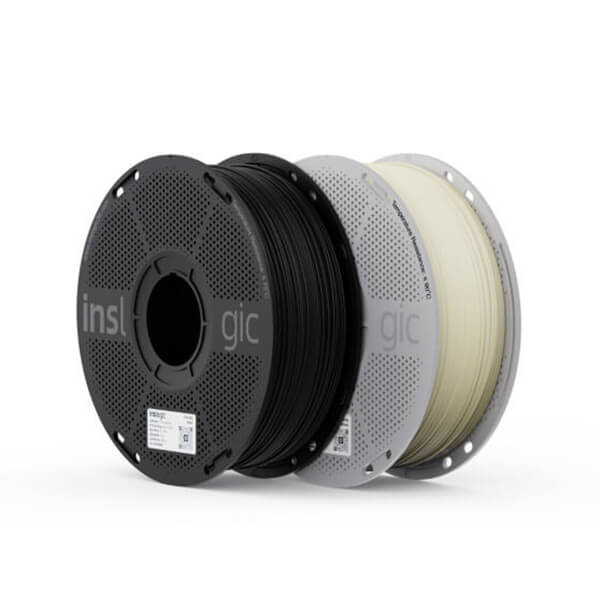

In the demanding world of functional 3D printing, there is a strict dividing line between aesthetic prototyping and true industrial manufacturing. When your project demands a material that will not melt near an engine block or shatter upon impact, engineers consistently turn to Polycarbonate (PC).
Renowned for its use in bulletproof glass and aerospace components, PC is the heavy-duty engine of engineering filaments. To demonstrate exactly what sets our formulation apart, we put Inslogic PC through three rigorous real-world tests against standard PLA Pro, measuring thermal stability, kinetic impact absorption, and light transmittance.
Beyond the Video: The Engineering Edge
While the visual tests speak for themselves, the raw laboratory data confirms Inslogic PC’s position as a premium engineering material. It is explicitly formulated for high-stress environments where failure is not an option.
- Thermal Dominance: Inslogic PC boasts a Heat Deflection Temperature (HDT) of 101°C at 0.45 MPa. This allows the material to withstand continuous high-temperature industrial applications without softening, warping, or losing structural integrity.
- Massive Impact Strength: Unlike rigid but brittle materials, PC absorbs massive kinetic energy. Standardized ISO testing confirms a notched Izod impact rating of 35 KJ/m². This remarkable durability makes it the premier choice for producing rigid, load-bearing parts.
- Superior Mechanical Output: The material delivers a tensile strength of 55 MPa and a flexural strength of 80 MPa. This balanced mechanical profile ensures your prints can handle continuous mechanical stress.
Advanced Industrial Applications
Because of its unique blend of toughness, heat resistance, and optical clarity, Inslogic PC unlocks applications that traditional polymers simply cannot handle:
- Electrical & Electronic Housings: PC exhibits excellent electrical insulation properties, making it highly suitable for low-volume, customized production of electronic cases and electrical component enclosures.
- Automotive & Aerospace: Ideal for under-the-hood automotive manufacturing, custom brackets, and aerospace functional prototypes where thermal resistance is mandatory.
- Manufacturing Line Tooling: Create durable, customized tool fixtures and industrial models that survive daily factory floor wear and tear.
- End-Use Protective Gear: Leverage its high light transmittance and shatter-resistant properties for clear protective covers, guards, and robust end-use parts.
Recommended Printing Parameters
To achieve optimal interlayer bonding and optical clarity, ensure your filament is thoroughly dried and printed within these targeted parameters:
- Filament Pre-Drying: 70-80°C for 4-5 hours.
- Nozzle Temperature: 260°C – 280°C.
- Bed Temperature: 100°C – 110°C on a Textured PEI Sheet.
Upgrade your printing arsenal with material built for the real world: